

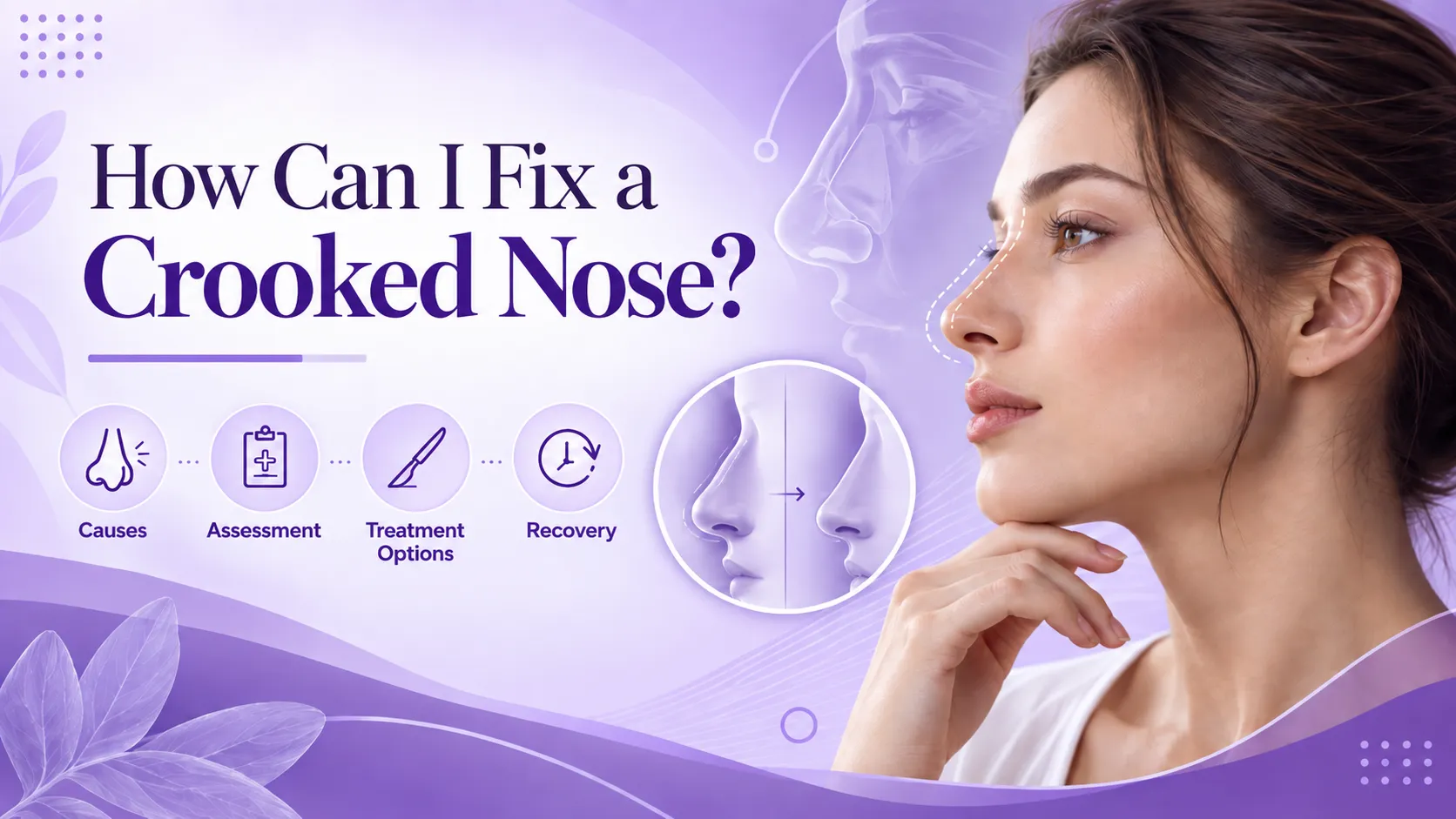
How Can I Fix a Crooked Nose?
A crooked nose can be something you are naturally born with, or it may develop later due to an injury, trauma, or previous nasal surgery. For some people, it is mainly an aesthetic concern that affects facial symmetry. However, when a crooked nose also makes it difficult to breathe, it may indicate an underlying structural issue that needs attention.
Although exercises, massages, and other natural methods are often suggested for straightening the nose, they cannot permanently change its underlying structure. Rhinoplasty is one of the treatment options that can help reshape a crooked nose and improve its overall appearance. The right treatment depends largely on what is causing the nose to appear crooked and whether the concern is related to its appearance, function, or both.
In this blog, we’ll discuss the common causes of a crooked nose, whether it can be fixed naturally, and the treatment options available for correcting it.
What Is a Crooked Nose?
A crooked nose is one that can be classified as off-center or not straight. This can be due to the side of the bridge being off to one side or the tip of the nose slightly pointing in one direction as well as one nostril being bigger than the other.
Having a little bit of asymmetry in the face is completely normal and a slightly crooked nose shouldn’t be a cause for concern.
Having an off-center nose can be caused by the asymmetric growth of the cartilage, septum, and/or bones of the nose. Having a severely uneven nose may play a role in asphyxiation as well as the appearance of having an off-center nose.
What Causes a Crooked Nose?
Some reasons for a crooked nose are congenital, acquired, or surgeon-related.
1. Natural Anatomy
Asymmetrical facial features can be congenital. Skin loses elasticity as we age and so do the connective tissues supporting the nose and cartilage. People may notice asymmetry in their face as they age.
2. Prior Nasal Injuries
Often, crooked noses are due to injuries. Contact sports or accidental trauma may fracture or displace the bones or cartilage of the nose. If the healing process is damaged as well, a crooked nose may be permanent.
3. Deviated Septum
The nasal septum separates the two nasal passages. If it is significantly deviated, it may cause asymmetry and an uneven appearance of the facial features.
Symptoms of a deviated septum may include one-sided nasal congestion, polyps on one side, and difficulty breathing as well as asthma on that side.
4. Previous Nasal Surgery
Changes from previous nasal surgeries may cause asymmetry as well as an irregular nasal shape. It depends on the changes and how asymmetry and nasal shape are treated.
Can a Crooked Nose Affect Breathing?
Not all crooked noses cause breathing difficulty. Some people have visible asymmetrical noses, but still don’t have a difficult time breathing.
When the nasal structures on the inside are also deviated, there is usually a restriction in the airflow. This can cause several breathing difficulties like:
- Blockage in one or both nostrils
- One nostril being chronically more blocked than the other
- Constantly feeling more congested on one side of the nose
- Breathing through the mouth, constantly, more often than not
- Snoring at times
A crooked nose, caused by an injury, that is also accompanied by breathing difficulties, is probably something you should get checked by a specialist.
How to Fix a Crooked Nose?
The best crooked nose fix depends on whether the concern is primarily aesthetic or functional.
Rhinoplasty
Rhinoplasty is a type of surgery to reshape the nose. Nasal bones and cartilage can be repositioned, replaced or removed altogether, depending on what can best achieve a well-balanced and symmetrical appearance.
Rhinoplasty is the correct surgery for external appearance problems of the nose. For structural breathing issues, problems separate from cosmetic issues, other surgeries may be needed.
Septoplasty
A septoplasty corrects a deviated nasal septum and as a result, improves airflow through the nose, but will not reshape the external appearance.
If the septum is straight and the nasal tip is bent, a septoplasty is often the best surgery, although it will not correct other external bends or crookedness.
Septorhinoplasty
Septorhinoplasty is preferred over other surgical interventions for nose reshaping and expected breathing improvements when the cartilage, septum, and nasal hinge joints are impacted.
Septorhinoplasty involves both the internal (septum) and external correction (reshaping of the nose). Thus, it is indicated in individuals who have a misaligned nasal bone and breathing difficulty.
Non-Surgical Rhinoplasty
In certain situations, irregularities in the appearance of the nose can be disguised with injectable fillers and made to look straighter.
While this technique provides some benefits, it should not be considered as a means to correct a crooked nose. This is because it adds volume to the aesthetic deficiency of the nose, but cannot reshape the nose.
The nose is a very vascular area with specific filler injection risks. Thus, consideration should only be given to this procedure after a qualified medical professional has evaluated the patient.
How to Fix Crooked Nose Naturally?
A lot of people are concerned about how to fix their crooked nose without surgery. The internet provides a variety of options which include the use of nose clips, exercises, massages, and forcibly adjusting the position of the nose.
Unfortunately, none of these methods can permanently realign the nasal bones, cartilage or the deviated septum. Certain soft tissues may respond to gentle massage by temporarily affecting swelling. However, that will not structurally correct an adult’s nose.
Similar to massage, nose-shaping devices affect cosmetic concerns of the nose only while in use.
In this case, a crooked nose may need to be evaluated by a professional to determine the underlying cause (whether bone, cartilage, or septal deviation) and whether treatment is required.
Which Crooked Nose Treatment Is Right for You?
There is no such thing as a one-size-fits-all treatment protocol. Your rhinoplasty surgeon may determine:
- Degree of asymmetry of the nose and its cause
- Position of the nasal bones
- Shape and strength of the cartilage
- Septal alignment
- Airflow of the nose
- Prior nose injuries or surgeries
- Your personal aesthetic expectations
The rhinoplasty procedure needs to be individualized and not focused on copying someone else’s nose.
When Should You See a Doctor?
It may be advisable to seek professional advice when:
- Your nose has become deformed as a result of an accident.
- You have problems breathing through your nose.
- One nostril is always blocked.
- You are worried about any deformity of your nose.
- The appearance of your nose influences your self-confidence.
- You have started experiencing symptoms since undergoing nose surgery previously.
A consultation will assist in identifying if the problem is associated with your nose bones, cartilage, septum or any other physical part.
Conclusion
Your nose may be crooked from natural facial features, a past trauma, a deviated septum, or prior surgery. Many people look online trying to find how to correct a crooked nose naturally; however, there is no true way to correct it using natural methods or remedies.
Depending on what goals you have, rhinoplasty, septoplasty, or septorhinoplasty can help fix cosmetic concerns and breathing. If you have an asymmetric nose, or if you feel that you have difficulty breathing, seeing a plastic surgeon can determine the best course of action for you.
Dr. Preeti Yadav, one of the best plastic surgeons in Gurgaon, can determine the best course of action for you based on what you show her regarding your messed-up nose and your goals.
Frequently Asked Questions
Can a crooked nose become worse with age?
Changes in skin elasticity, cartilage, and other supporting tissues can alter the appearance of the nose over time. However, the extent of these changes varies from person to person.
Can a crooked nose be fixed after an old injury?
Yes. A crooked nose caused by a previous injury can often be corrected with surgery. The appropriate procedure depends on which nasal structures were affected and whether there are breathing problems.
How long does it take to recover from crooked nose surgery?
Initial recovery usually takes a few weeks, but swelling can take several months to fully settle. Your recovery time will depend on the type and extent of the procedure performed.
Will a crooked nose surgery leave a scar?
The presence and visibility of scars depend on the surgical technique used. In some rhinoplasty procedures, incisions are made inside the nose, while an open approach may involve a small incision on the skin between the nostrils.
Can I get rhinoplasty if I have breathing problems?
Yes. When both the appearance and internal structure of the nose need correction, a procedure such as septorhinoplasty may be considered after a proper evaluation.